
 by

Most UK clients I speak with arrive carrying the same spreadsheet. One tab shows a London flat earning 4 or 5% before a mountain of costs. The other shows a Dubai apartment advertised at 7%, “tax-free”. What they really want to know is whether that second tab is too good to be true.
It isn’t, but it isn’t the whole picture either. Buying property in Dubai from the UK makes a lot of sense for the right investor, and if you’ve been researching buying property in Dubai from UK shores, you’ll need to understand one thing from the start: tax-free in Dubai doesn’t mean tax-free for you if you’re a UK resident. Here’s the honest comparison.
Yields: Dubai vs London
Let’s start with the number that brings most British investors here.
| Metric | London | Dubai |
|---|---|---|
| Typical gross yield | About 5.1% average (Zoopla); lower in prime central | 7.15% apartments, 4.98% villas (Property Monitor, April 2026) |
| Purchase tax | SDLT bands plus 5% surcharge on additional homes | 4% DLD transfer fee plus fixed fees |
| Annual property tax | Council tax (usually paid by tenants) | None |
| Local tax on rent | UK income tax | None in the UAE |
| Latest rental growth | 2.9% in London (Zoopla, Sept 2026) | Renewal increases capped by the RERA rental index |
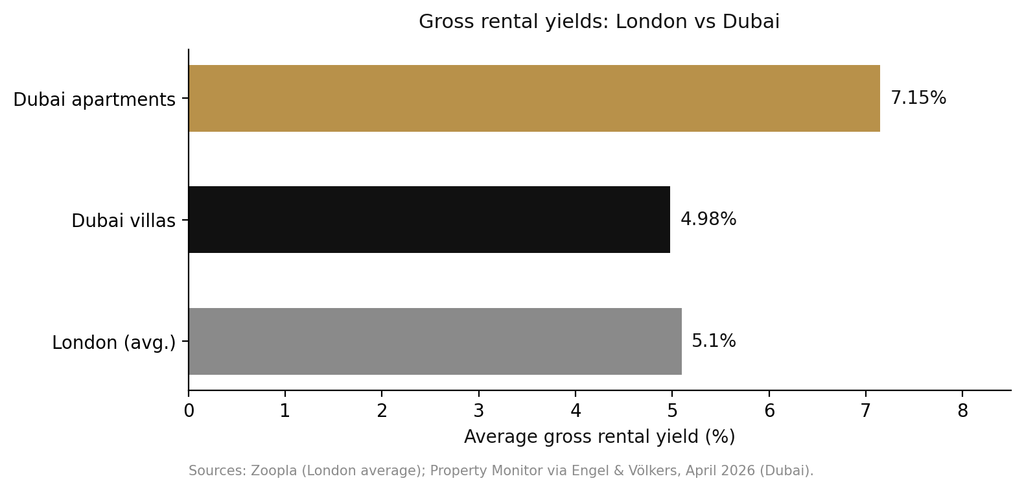
Figure: Average gross rental yields, London vs Dubai.
London sits at the bottom of the UK yield table at roughly 5.1% gross on Zoopla’s figures, with prime central postcodes lower still. Dubai apartments averaged 7.15% in April 2026. On a £400,000 investment, a two-point gap is about £8,000 a year before tax. One caveat: Dubai villas yield closer to London levels, so the income advantage is really an apartment story.
Your UK Tax Position (Where Most People Get Caught)
The UAE doesn’t tax your rent and has no capital gains tax on individuals. But if you’re UK tax resident, HMRC taxes your worldwide income and gains. Here’s what applies when buying property in Dubai from UK residence:
- Rental income. Dubai rent is declared as overseas property income on your Self Assessment return. For 2026/27 it’s taxed at 20%, 40% or 45%. From 6 April 2027, new property income rates of 22%, 42% and 47% apply in England, Wales and Northern Ireland, and they explicitly include overseas property profits.
- No foreign tax credit. As the UAE charges no tax on the rent, there’s nothing to offset. The UK tax is your full bill.
- Deductible costs. Service charges, management fees, repairs and letting costs can generally be deducted. Mortgage interest is restricted to a basic-rate tax credit, just as with a UK buy-to-let.
- Capital gains. Sell while UK resident and CGT applies at 18% or 24%, calculated in sterling. Because the dirham is pegged to the US dollar, exchange-rate moves can create or shrink a taxable gain.
- The non-dom regime has gone. Since 6 April 2025, the remittance basis has been replaced by a four-year foreign income and gains regime, available only to new arrivals after ten years of non-residence.
- Inheritance tax. Also from April 2025, IHT became residence-based. If you’ve been UK resident for 10 of the last 20 years, your Dubai property sits within the UK IHT net.
The UK and UAE do have a double taxation agreement, which mostly becomes relevant if you later move to Dubai and become UAE tax resident. That’s a different plan with its own rules, including the five-year temporary non-residence rule for gains. Speak to a UK tax adviser before you buy, not after.
So Is Dubai Still Better After Tax?
Usually, yes, though by less than the brochures suggest. Here’s an illustrative comparison for a higher-rate taxpayer under the 2027 rates, using typical net yields after running costs:
| Per £100,000 invested | London flat | Dubai apartment |
|---|---|---|
| Net yield before tax | 3.2% | 4.8% |
| Net income before tax | £3,200 | £4,800 |
| UK tax at 42% | −£1,344 | −£2,016 |
| Income after tax | £1,856 | £2,784 |
Dubai still tends to win on income. The other differences, lower entry taxes, no annual property tax and a deep pool of new-build stock, add to the case. Just don’t let “tax-free” drive the decision.
The Process: Buying Property in Dubai From UK, Step by Step
- Set your budget in dirhams. Add around 7–8% for costs. Transaction fees must be paid in cash; banks won’t finance them.
- Line up finance early if you need it. Some UAE banks lend to UK residents, but loan-to-value limits for non-residents are lower than for UAE residents. Many UK buyers use cash or equity released at home.
- Choose a RERA-registered agent and property. Check listings carry a valid DLD advertising permit and pull recent transaction data for the building.
- Sign Form F (the MOU). This standard DLD contract fixes the price, terms and deposit, usually 10% on a resale.
- The seller obtains the NOC. The developer confirms there are no outstanding service charges before transfer.
- Transfer at a DLD trustee office. Attend in person, or appoint someone through a Power of Attorney that’s notarised in the UK, legalised by the FCDO, attested by the UAE Embassy in London, then by the UAE Ministry of Foreign Affairs, and translated into Arabic.
- Receive your title deed. It’s issued in your name once the transfer is registered.
Buying off-plan works slightly differently. You buy directly from the developer, the sale is registered through Oqood, and your payments go into the project’s DLD-registered escrow account. Foreign nationals can buy freehold in designated areas with just a passport; no UAE residency is needed.
Most clients buying property in Dubai from UK addresses complete without flying in more than once. Video viewings, digital signing and a properly prepared POA make remote buying routine.
What UK Landlords Often Underestimate
- Service charges. These are paid by the owner, not the tenant, and vary widely between buildings. Always ask for the latest invoice before you commit.
- How rent is paid. Annual rent in Dubai is commonly paid in a small number of cheques rather than monthly transfers, which is great for cash flow but means a void period hits harder.
- Short-term letting rules. Running a unit as a holiday home requires a permit from Dubai’s Department of Economy and Tourism, and some buildings restrict it altogether.
- Currency timing. Your rent arrives in dirhams, so the sterling value of each payment moves with the pound against the US dollar.
- Record keeping for HMRC. Keep every invoice, tenancy contract and bank statement. You’ll need them to calculate taxable profit and, later, your capital gain.
Is Buying Property in Dubai From UK Right for You?
If you want stronger gross income, lower entry taxes and exposure to a dollar-pegged currency, and you’re comfortable paying UK tax on the profits, it can be a strong addition to a UK-heavy portfolio. If you were hoping for tax-free income while still living in Surrey, the numbers need a rethink.
| Talk It Through on UK Time. Whether you’re in London, Manchester or Edinburgh, our team at Black Swan Real Estate regularly works with UK-based buyers over video calls scheduled around UK hours. We’ll shortlist, pull the building data and coordinate everything on the ground. Email info@blackswanrealestate.ae, or if you’re passing through Dubai, drop by and see us at our Business Bay office. |
Frequently Asked Questions
Can UK citizens buy property in Dubai?
Yes. Foreign nationals can buy freehold in designated areas with a passport; no UAE residency is needed.
Do I pay UK tax on Dubai rental income?
Yes, if you’re UK tax resident. It’s declared as overseas property income on Self Assessment.
Is there capital gains tax on Dubai property for UK residents?
Not in the UAE, but UK residents pay UK CGT at 18% or 24% on the gain.
Do I need to fly to Dubai to complete?
Not necessarily. A properly legalised Power of Attorney lets a representative complete the transfer.
Which yields more for a UK investor, Dubai or London?
Dubai apartments averaged 7.15% gross in April 2026, versus around 5% for London overall.



Join The Discussion